XTS Insights beginner guide to the wallet logic behind Bitcoin transaction inputs
Introduction
When a Bitcoin wallet shows a balance, the number can look similar to a bank account balance. Under the surface, however, the wallet usually controls a collection of separate unspent transaction outputs, known as UTXOs.
When you send Bitcoin, the wallet must decide which of those UTXOs to use as transaction inputs. That decision is called coin selection.
Coin selection may appear to be a simple task: choose enough Bitcoin to cover the payment. In practice, a wallet also needs to estimate the transaction fee, decide whether to create change, consider the future cost of spending that change, follow its security and confirmation policies, and avoid unnecessary privacy leaks.
Different choices can produce transactions with different fees, sizes, privacy characteristics, and future wallet costs, even when the recipient receives exactly the same amount.
This XTS Insights guide explains how Bitcoin coin selection works, why wallets use different strategies, how change addresses fit into the process, and what users should understand before manually choosing UTXOs.
What Is Bitcoin Coin Selection
Bitcoin coin selection is the process a wallet uses to choose which available UTXOs will become the inputs of a new transaction.
A wallet may control one UTXO or thousands of them. To create a valid payment, the selected inputs must provide enough value for:
The amount being sent to the recipient
The transaction fee paid to miners
Any additional outputs requested by the user
If the selected value is greater than the payment and fee, the wallet normally returns the remainder to itself through a change output.
Coin selection is wallet logic. It is not a Bitcoin consensus rule, and the Bitcoin network does not require every wallet to use the same algorithm. Wallet developers can choose different methods as long as the final transaction follows Bitcoin’s validation rules.
The Short Answer
A Bitcoin wallet reviews the UTXOs it is allowed to spend, estimates the cost of using each one, and searches for a combination that can fund the payment and fee. It then evaluates tradeoffs such as transaction size, change creation, privacy, and future spending cost before building the transaction.
The general relationship is:
Selected input value = recipient outputs + change output + transaction fee
If no change output is created, any remaining value becomes part of the transaction fee.
Why Bitcoin Needs Coin Selection
Bitcoin does not maintain balances in the same way as a bank ledger. Instead, the blockchain records transaction outputs. An output that has not yet been spent is a UTXO.
Suppose a wallet has received four payments over time:
0.010 BTC
0.025 BTC
0.040 BTC
0.100 BTC
The wallet may display a total balance of 0.175 BTC, but the funds still exist as four separate UTXOs. If the owner wants to send 0.050 BTC, the wallet must choose one or more of those outputs as inputs.
It could use the 0.100 BTC UTXO and return change. It could combine 0.010 BTC and 0.040 BTC if that combination can also cover the fee. It could choose 0.025 BTC and 0.040 BTC. Each choice has different consequences.
Coin selection is the process of comparing those possibilities.
A Quick UTXO Refresher
A UTXO is a specific amount of Bitcoin locked by a spending condition. A wallet can spend it when it can satisfy that condition, usually by producing a valid digital signature.
UTXOs behave more like individual pieces of cash than entries in a single balance. When one is used as an input, it is consumed in full. The transaction then creates new outputs.
For example, spending a 0.100 BTC UTXO does not remove only 0.030 BTC from that output. The entire 0.100 BTC becomes an input. The transaction can send 0.030 BTC to the recipient, pay a fee, and return the remainder as change.
This all-or-nothing input model is the reason coin selection and change outputs are necessary.
What a Wallet Must Fund
Before selecting UTXOs, a wallet needs to determine the transaction target.
The target normally includes:
The total value of all recipient outputs
The fee needed for the expected transaction size
Any additional output requested by the user or application
The fee cannot always be known exactly before the inputs are selected because each additional input increases transaction weight. The wallet therefore estimates the fee, tests a possible selection, and adjusts the calculation as needed.
This creates a feedback loop: input selection affects transaction size, and transaction size affects the fee that the selected inputs must cover.
How Bitcoin Coin Selection Works
Wallet implementations differ, but the process usually follows the same broad sequence.
Step 1 The Wallet Defines the Payment
The wallet begins with the recipient amount, destination address, fee target, and any user settings. If several recipients are included, their output values are added together.
The wallet also estimates the non-input portion of the transaction, including the version, locktime, output scripts, and other required data.
Step 2 The Wallet Identifies Eligible UTXOs
Not every UTXO controlled by the wallet is necessarily available for the payment.
A wallet may exclude outputs that are:
Frozen or manually locked
Reserved for another transaction
Unconfirmed when wallet policy requires confirmations
Immature coinbase outputs
Controlled by a watch-only policy without signing access
Associated with an account or label the user did not select
Uneconomical to spend at the current fee rate
The remaining outputs form the candidate pool.
Step 3 The Wallet Estimates Each Input Cost
Adding an input increases transaction weight, which increases the fee. The cost depends partly on the output type being spent because different scripts require different witness or signature data.
Wallet software can calculate an effective value for a UTXO:
Effective value = UTXO value — estimated fee to spend that UTXO
A small UTXO may have little effective value when fees are high. In extreme cases, spending it can cost as much as or more than the value it contributes.
Step 4 The Wallet Evaluates Candidate Combinations
The wallet searches for one or more combinations that can fund the target. It may prefer an exact or near-exact match, a low-weight set, a privacy-preserving group, or a selection that helps manage the wallet’s UTXO pool.
There can be many valid combinations. A wallet with dozens of UTXOs may have an enormous number of possible input sets, so practical algorithms limit the search and compare the best candidates they find.
Step 5 The Wallet Decides Whether to Create Change
If a selection exceeds the payment and fee, the wallet considers creating a change output.
Change is useful, but it also has costs:
The change output makes the current transaction larger
Spending that change later creates another input cost
A detectable change output can reveal information about the wallet
If the excess is too small to create and spend economically, the wallet may add it to the fee instead. If a suitable near-exact selection exists, the wallet may create a transaction without change.
Step 6 The Wallet Chooses a Preferred Result
The wallet compares valid selections using its own policy. It may consider current fees, expected future fees, input weight, change cost, privacy, confirmation status, and user coin-control settings.
The chosen inputs are then placed into an unsigned transaction together with the recipient and change outputs.
Step 7 The Transaction Is Signed and Broadcast
The wallet or connected signing device verifies the transaction details and signs each selected input. After signing, the transaction can be broadcast to the Bitcoin network.
Nodes validate the completed transaction according to Bitcoin’s consensus and relay policies. They do not evaluate whether the wallet made an efficient or private coin-selection decision.
A Simple Coin Selection Example
Imagine a wallet controls these UTXOs:
UTXO A = 0.020 BTC
UTXO B = 0.035 BTC
UTXO C = 0.060 BTC
UTXO D = 0.120 BTC
The user wants to send 0.050 BTC plus a transaction fee.
Several selections could work:
UTXO C alone provides enough value and creates a relatively small change output
UTXO A plus UTXO B may be close to the target but uses two inputs and therefore more transaction weight
UTXO D alone uses only one input but creates a much larger change output
Several smaller UTXOs may help consolidate the wallet but can increase the current fee
The best choice depends on the fee rate, script type, wallet policy, privacy history, and expected future cost. Looking only at the face value of each UTXO is not enough.
What Is Effective Value
Effective value helps a wallet compare UTXOs after accounting for the fee required to include them as inputs.
Suppose two UTXOs have the same nominal value but use different script types. If one requires more transaction weight to spend, its effective value is lower at the same fee rate.
Effective value also changes with network fees. A small UTXO may be useful when fees are low but uneconomical when fees are high.
This does not mean the UTXO has disappeared or become invalid. It means that using it in the current transaction may add little or no practical spending power after fees.
What Is the Waste Metric
Some wallets compare candidate selections with a concept often called waste.
In broad terms, a waste calculation can consider:
The cost of spending selected inputs at the current fee rate
The estimated long-term cost of spending those inputs
The cost of creating and later spending change
Excess value that would be added to the fee when no change is created
The goal is not simply to minimize today’s fee. A selection with a slightly larger current transaction might reduce future costs, while a selection that looks cheap now might create change that is expensive to spend later.
Bitcoin Core’s implementation uses a waste metric when comparing certain coin-selection results. Wallet implementations can use different formulas and assumptions.
The Main Goals of Coin Selection
Coin selection usually balances several objectives rather than optimizing a single number.
Fund the Transaction Reliably
The selected inputs must cover the outputs and fee with enough margin for the final transaction structure.
Control Transaction Fees
Each input adds data. Using fewer or lighter inputs can reduce transaction weight and the fee paid at a given fee rate.
Avoid Unnecessary Change
A near-exact match can avoid the current and future cost of a change output. A wallet should not force a changeless transaction if the excess fee would be unreasonable.
Protect User Privacy
Combining UTXOs can link addresses and payment histories. Privacy-aware wallets may avoid mixing unrelated groups of funds when possible.
Manage the UTXO Pool
Wallets that receive many small payments can accumulate a large number of UTXOs. Selecting extra inputs when fees are low may reduce future complexity, but it can also increase the current transaction size.
Follow Wallet Policy
Wallets may respect labels, frozen outputs, confirmation requirements, avoid-reuse settings, and other user preferences.
Coin Selection and Transaction Fees
Bitcoin transaction fees are based primarily on transaction weight, not the amount of Bitcoin being transferred.
Inputs often make up a large part of that weight. A transaction using ten small inputs can cost more than one using a single larger input, even if both send the same amount.
Coin selection therefore has a direct effect on fees.
A wallet typically considers:
The number of inputs
The script type and estimated input weight
The number and type of outputs
The selected fee rate
Whether a change output is needed
The cheapest selection today is not always the cheapest over the full life of the wallet. Future spending cost also matters.
Coin Selection and Change Addresses
Coin selection determines how much change a transaction creates.
If selected inputs total 0.080 BTC and the payment plus fee totals 0.051 BTC, the wallet has approximately 0.029 BTC remaining. It normally sends that remainder to a new change address controlled by the same wallet.
A different input selection might create less change or no change at all.
This is why Article 24 on Bitcoin change addresses and this article are closely connected. Change is the result of selecting inputs whose value exceeds the transaction target.
Common Coin Selection Strategies
Wallets can use one strategy or combine several approaches.
Exact Match or Changeless Selection
The wallet searches for inputs whose effective value closely matches the target. If successful, it can avoid creating a change output.
This can reduce future spending cost and sometimes make change identification more difficult. The wallet must still avoid paying an excessive fee through over-selection.
Lowest Weight Selection
The wallet looks for a combination that funds the transaction with relatively little input weight. This can be useful when fees are high.
Smallest Sufficient Input
The wallet may choose the smallest single UTXO that can cover the target. This is simple but does not always produce the best privacy or long-term fee outcome.
Consolidation Selection
When fee rates are low, a wallet may include additional small UTXOs to reduce the number of outputs it must manage later.
Consolidation can lower future costs, but it may link previously separate coins and make the current transaction larger.
Randomized Selection
Randomization can make wallet behavior less predictable. Random selection alone does not guarantee privacy and may create inefficient transactions.
Manual Coin Control
Some wallets allow the user to choose exact UTXOs. This is called coin control.
Coin control can help separate accounts, avoid spending certain outputs, consolidate funds, or preserve a particular payment history. It can also produce higher fees or privacy mistakes when used without understanding the tradeoffs.
Coin Selection in Bitcoin Core
Bitcoin Core’s wallet code provides a useful example of how sophisticated coin selection can become. Its current source includes several algorithm types, and the implementation can evolve between releases.
Examples include:
Branch and Bound or BnB, which searches for a selection within a target range that can avoid creating change
Knapsack, an approach that searches subsets of available outputs
Single Random Draw or SRD, which adds candidates in randomized order until the target is reached
CoinGrinder, which searches for a low-weight input set for a transaction that includes change
Manual, used when inputs are selected directly
Bitcoin Core can produce candidate selections and compare them using a waste score. The presence of these examples does not mean all wallets behave the same way, and users should not assume a fixed algorithm across every release.
Why There Is No Universal Best Algorithm
Coin selection involves real tradeoffs.
A fee-minimizing choice can combine coins that the user wanted to keep separate. A privacy-focused choice can require more inputs. A changeless transaction can pay more fee than a transaction that creates change. Consolidation can reduce future costs while revealing that multiple UTXOs belong to the same wallet.
The best result depends on the user’s purpose, wallet history, current fee market, future expectations, and software policy.
For this reason, Bitcoin’s protocol defines transaction validity but leaves coin-selection policy to wallets.
Privacy Considerations
Coin selection can reveal relationships between funds.
Common Input Ownership Heuristic
When several UTXOs appear as inputs in one transaction, blockchain analysts may infer that one entity controlled the keys required to spend them. The inference is not always correct, but it is widely used.
Combining unrelated UTXOs can therefore connect address histories that were previously separate.
Change Identification
If one output is recognized as payment and another as change, observers may follow the change into later transactions. Wallets use fresh change addresses, but address freshness alone does not remove every transaction-pattern clue.
Partial Spend Avoidance
Some wallet policies group outputs received at the same address and try to spend the group together. This can reduce repeated exposure of address ownership, though it may require more inputs and higher fees.
Labels and Accounts
Wallet labels can help users avoid mixing business funds, personal savings, donations, or other categories. The privacy benefit depends on how consistently the wallet applies those boundaries.
UTXO Consolidation
UTXO consolidation means combining several smaller UTXOs into fewer, larger outputs, usually by sending funds back to the same wallet.
Coin selection may perform some consolidation as part of a normal payment, especially when fee rates are low. Bitcoin Core, for example, exposes a consolidation fee-rate policy that can permit more inputs than strictly necessary under certain conditions.
Consolidation can reduce future transaction size, but users should consider:
The current fee rate
The future value of simplifying the UTXO set
The privacy impact of linking inputs
Whether the destination and change policies are correctly backed up
There is no guarantee that fees will be lower later, so consolidation remains a planning decision rather than a certainty.
Uneconomical UTXOs and Dust
A UTXO can be valid yet uneconomical to spend at a particular fee rate.
Wallets often distinguish between:
Dust outputs, which fall below policy thresholds related to their spending cost
Economically small UTXOs, which are above dust limits but contribute little effective value at current fees
Coin selection may ignore outputs with non-positive effective value unless a special consolidation policy applies.
Users should not assume that a displayed balance will always be spendable at the same cost. A wallet with many tiny UTXOs may need a much larger transaction than a wallet holding the same balance in a few outputs.
Confirmations and Spend Eligibility
Wallets can treat confirmed and unconfirmed UTXOs differently.
An unconfirmed incoming payment may be valid but still depend on a parent transaction in the mempool. Spending it creates a transaction chain and may affect relay, fee bumping, or confirmation expectations.
Wallet policies can also exclude:
Outputs from transactions that conflict with another transaction
Outputs locked by timelock conditions
Coinbase rewards that have not reached maturity
Outputs the user has frozen
Coin selection therefore evaluates more than value alone.
Coin Control for Advanced Users
Coin control gives users direct influence over input selection.
It can be useful when a user wants to:
Keep separate sources of funds apart
Spend a specific UTXO
Avoid touching long-term savings
Consolidate small outputs during a low-fee period
Select inputs needed for a collaborative or audited transaction
Before confirming a manually selected transaction, review:
The selected inputs and their labels
The recipient address and amount
The change address and change amount
The fee rate and total fee
The privacy effect of combining the inputs
Whether any unconfirmed parent transactions are involved
Manual selection overrides some wallet automation. It should be used deliberately.
Hardware Wallets Multisig and PSBTs
Coin selection usually happens before signing.
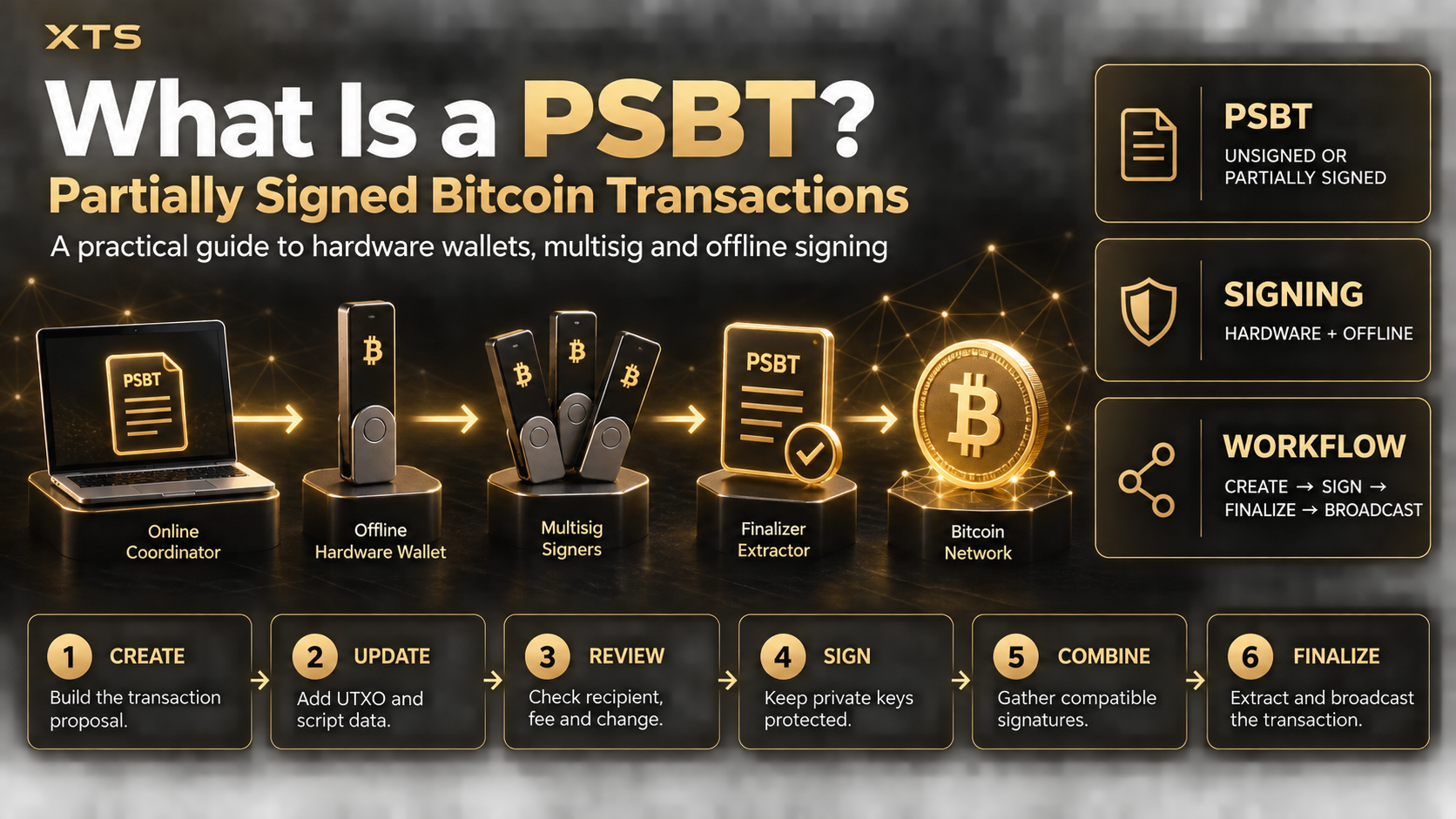
In a hardware-wallet setup, the software wallet may choose the UTXOs and construct a transaction or PSBT. The hardware wallet then displays or verifies transaction details before signing.
In multisignature workflows, a coordinator often performs coin selection and creates a PSBT for the required signers. Every participant should verify the recipient outputs, change output, fee, and policy before approving it.
A signing device does not automatically guarantee that the coordinator made the best privacy or fee choice. It confirms authorization for the transaction presented to it.
Coin Selection and Fee Bumping
Coin selection can affect later fee-bumping options.
With Replace by Fee, a wallet may rebuild the transaction with a higher fee. Depending on the wallet and available value, it may reduce change or add another input.
With Child Pays for Parent, a wallet spends an output from an unconfirmed transaction and pays enough fee for the package. This requires a suitable spendable output, often the wallet’s change.
Good transaction construction leaves the wallet with clear options, but no coin-selection method can predict every future fee-market condition.
Common Mistakes to Avoid
Selecting the Largest UTXO Every Time
This may keep input count low but can create large change outputs and repeat a recognizable pattern.
Combining All Small UTXOs Without Checking Privacy
Consolidation can link many payment histories in one transaction.
Ignoring the Total Fee
A reasonable fee rate can still produce a high total fee when many inputs are selected.
Assuming Manual Selection Is Always Better
Modern wallets can evaluate more combinations and cost factors than a person can easily compare by sight.
Treating Change as an Extra Fee
Change remains under the wallet’s control. It is separate from the miner fee.
Using Unconfirmed Inputs Without Understanding the Chain
The new transaction may depend on earlier transactions and inherit their confirmation problems.
Common Misconceptions About Coin Selection
The Wallet Spends From One Balance
The displayed balance is an interface summary. Transactions spend specific UTXOs.
The Network Chooses the Inputs
The wallet chooses inputs before broadcast. Nodes later verify that the selected inputs exist, are unspent, and satisfy their locking conditions.
The Biggest UTXO Is Always Cheapest
Input weight, script type, change, privacy, and future cost all matter.
A Changeless Transaction Is Always Best
Avoiding change can be beneficial, but not when the transaction discards an unreasonable amount as fee.
Coin Selection Can Make an Invalid Transaction Valid
Coin selection only chooses candidates. The final transaction still has to satisfy Bitcoin’s consensus rules and applicable relay policy.
How XTS Views Bitcoin Coin Selection
At XTS, we view coin selection as an important bridge between Bitcoin’s UTXO model and the everyday wallet experience.
Users usually see a balance and a Send button. The wallet must translate that simple request into a technically valid transaction with specific inputs, outputs, change, and fees.
Understanding coin selection helps users explain why two payments of the same amount can have different fees, why a wallet may create change, why small UTXOs can become expensive to spend, and why manual coin control affects privacy.
The practical lesson is straightforward: use transparent wallet software, review transaction details before signing, and use manual input selection only when you understand the tradeoffs.
Frequently Asked Questions
What Is Bitcoin Coin Selection in Simple Terms
Bitcoin coin selection is the process a wallet uses to choose which UTXOs will fund a payment and its transaction fee.
Who Performs Coin Selection
Wallet software normally performs coin selection before the transaction is signed. A user can override or guide the process when the wallet supports coin control.
Is Coin Selection a Bitcoin Consensus Rule
No. Bitcoin’s rules determine whether a completed transaction is valid. Wallets can use different input-selection policies.
Why Does My Wallet Use Several Inputs
The wallet may not have one eligible UTXO large enough to cover the payment and fee. It may also be consolidating outputs or following privacy and policy settings.
Why Does Using More Inputs Increase the Fee
Each input adds transaction data. More transaction weight requires a higher total fee at the same fee rate.
Can Coin Selection Avoid a Change Output
Sometimes. If the wallet finds inputs whose effective value closely matches the target, it may build a transaction without change.
What Is Manual Coin Control
Coin control lets the user choose specific UTXOs instead of accepting the wallet’s automatic selection.
Is Manual Coin Control More Private
It can support privacy when used carefully, but poor choices can link more funds and reveal more information than automatic selection.
What Happens to UTXOs That Are Too Small to Spend Economically
They remain valid UTXOs. A wallet may leave them unused until fee conditions or consolidation policies make spending them practical.
Do All Bitcoin Wallets Use the Same Algorithm
No. Algorithms and policies differ across wallets and can change between software releases.
Can a Hardware Wallet Choose the Inputs
The connected wallet software or coordinator often selects inputs and prepares the transaction. The hardware wallet then verifies details and signs according to its capabilities and policy.
How Is Coin Selection Related to Change Addresses
When selected inputs exceed the payment and fee, the wallet normally returns the remainder to a change address it controls.
Conclusion
Bitcoin coin selection is the wallet process that turns a collection of UTXOs into the inputs of a new transaction.
The wallet must fund the recipient outputs and fee while considering transaction weight, effective value, change creation, privacy, confirmation status, and future spending cost. Because these goals can conflict, there is no single best strategy for every wallet and every payment.
For most users, automatic coin selection offers the safest balance of convenience and policy. Advanced users can apply coin control when they need specific accounting, privacy, or UTXO-management outcomes, but they should review the total fee and the relationships revealed by combining inputs.
Understanding this process makes Bitcoin wallet behavior easier to interpret and provides the foundation for learning about UTXO consolidation, dust, transaction batching, and fee management.
Key Takeaways
- Coin selection chooses which UTXOs become transaction inputs
- Selected inputs must cover recipient outputs and transaction fees
- Input count and script type affect transaction weight and total fees
- Effective value subtracts the estimated spending cost from a UTXO’s face value
- Wallets may compare current fees, future costs, change, and privacy
- Changeless selection can help but is not always the best result
- Manual coin control can improve control while increasing user responsibility
- Different wallets can use different algorithms and policies