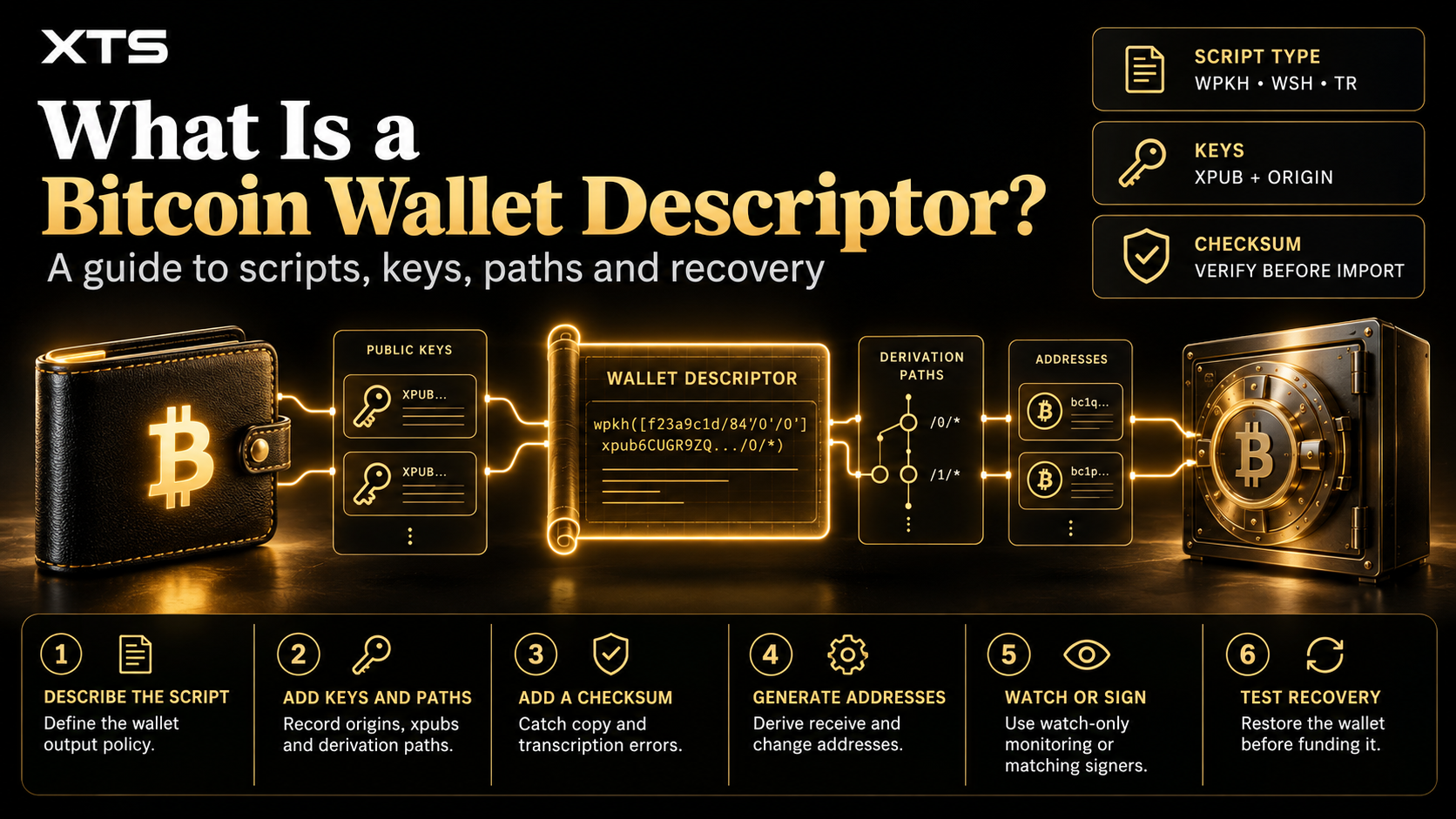
A beginner-friendly guide to output descriptors, scripts, keys, derivation paths, checksums, watch-only wallets, and recovery planning.
Introduction
A Bitcoin wallet is more than a seed phrase and a list of addresses. To recreate a wallet correctly, software may also need to know which script type it uses, how keys are derived, which paths belong to receiving and change addresses, and whether several public keys must work together.
That is the problem a Bitcoin wallet descriptor, also called an Output Descriptor, is designed to solve. A descriptor is a structured instruction that tells compatible wallet software how keys and scripts relate to the addresses and spendable outputs a wallet controls.
Descriptors are especially useful for watch-only wallets, hardware-wallet coordination, multisig recovery, wallet migration, and long-term backup planning. They do not replace private keys, and they do not contain a wallet balance. Instead, they preserve the wallet’s spending policy and address-generation logic in a form software can understand.
In our previous XTS Insights article, What Is Bitcoin Multisig?, we explained why a multisig wallet needs more than a single recovery phrase. Descriptors provide one practical way to record the policy, public keys, and derivation information that help a compatible wallet find and manage those funds again.
This guide explains what descriptors are, what they contain, how they differ from seeds and xpubs, and how to build a recovery plan that can be tested before significant funds are deposited.
The Short Answer: What Is a Bitcoin Wallet Descriptor?
A Bitcoin wallet descriptor is a machine-readable description of how a wallet creates and recognizes Bitcoin output scripts, public keys, derivation paths, and addresses. It acts like a blueprint for the wallet’s policy rather than a secret that authorizes spending.
A descriptor can describe a single-key wallet, a multisig policy, a Taproot construction, or another supported script type. It may include key-origin information, extended public keys, derivation paths, a wildcard for address indexes, and a checksum that helps detect copying mistakes.
A descriptor by itself normally cannot spend Bitcoin. Spending still requires the appropriate private keys or signing devices. A descriptor can, however, help a watch-only wallet generate addresses, track funds, identify change outputs, and reconstruct the policy needed for recovery.
Why Key-Only Backups Can Be Incomplete
A seed phrase is extremely important because it can regenerate deterministic key material. But a seed phrase does not always tell recovery software everything it needs to rediscover a wallet’s funds.
The same seed can be used with different script types, account branches, address formats, or derivation paths. A wallet that used native SegWit addresses may not be restored correctly if software searches only legacy paths. A multisig wallet may require several extended public keys and a threshold policy that no single seed can describe.
Recovery may therefore require information such as:
The output script type, such as `wpkh`, `wsh`, or `tr`.
The derivation path and key-origin information.
The receiving and change branches used by the wallet.
The public keys or xpubs that form a shared policy.
The multisig threshold and key ordering rules, when applicable.
The wallet creation or scan details needed to find historical activity.
This does not make seed phrases unimportant. It means a serious backup plan should preserve both the secret key material and the wallet policy that tells software how to use it.
What Is an Output Descriptor?
An Output Descriptor is a compact language for describing collections of Bitcoin output scripts. It uses function-like expressions to represent how a wallet turns keys into scripts and addresses.
For example, `wpkh(…)` describes a native SegWit pay-to-witness-public-key-hash construction. `wsh(…)` describes a pay-to-witness-script-hash construction, which is often used for script-based multisig. `tr(…)` describes a Taproot output. The exact expressions supported depend on the wallet software and the descriptor version it implements.
A descriptor is therefore closer to a recipe than to an account number. It explains how to derive the addresses a wallet should watch and the conditions a spending transaction must satisfy.
What Information Can a Descriptor Contain?
Script or Output Type
The outer expression tells the wallet what kind of output script to construct. Common examples include `pkh`, `wpkh`, `sh`, `wsh`, `tr`, `multi`, and `sortedmulti`.
The script type affects address format, transaction size, fee impact, privacy characteristics, hardware-wallet support, and recovery behavior. Two wallets can use the same key material but produce different addresses if they use different output expressions.
Key Expressions
A key expression can contain a public key, an extended public key such as an xpub, or—when kept private—an extended private key. A descriptor used for monitoring should normally contain only public information.
The key expression may include an origin fingerprint and the path that led to the key. This information helps software understand where the key came from and how to derive related child keys.
Derivation Paths and Wildcards
Wallets usually derive many addresses from one key tree. A path might identify an account, a change branch, and an address index. A wildcard such as `/*` commonly means “continue deriving child indexes here.”
Some descriptor formats also support multipath notation such as `<0;1>` to represent external and internal branches. Do not assume that every wallet interprets a path in exactly the same way; confirm the documented format before importing or restoring it.
Checksum
Many descriptors end with a checksum after a `#` character. The checksum is not encryption and does not prove that the descriptor came from a trusted source. Its purpose is to help detect transcription or copy-and-paste errors before the descriptor is imported.
Always copy the complete descriptor, including its checksum, when the wallet provides one. If a tool recalculates a checksum, compare the result with the trusted original rather than silently accepting a changed string.
Reading a Simple Descriptor Example
Consider this illustrative single-key example:
`wpkh([abcd1234/84h/0h/0h]xpub…/0/*)#checksum`
This is not a real wallet backup and is not ready to import. It simply shows the parts a descriptor may contain:
`wpkh` identifies a native SegWit public-key-hash output.
`[abcd1234/84h/0h/0h]` shows example origin information and a derivation path.
`xpub…` represents an extended public key. The shortened text is only a placeholder.
`/0/*` illustrates an external branch followed by a changing address index.
`#checksum` represents the descriptor checksum.
An illustrative 2-of-3 script-based multisig descriptor might look conceptually like:
`wsh(sortedmulti(2,[origin-A]xpub-A/0/*,[origin-B]xpub-B/0/*,[origin-C]xpub-C/0/*))#checksum`
Here, `wsh` describes the script wrapper, `sortedmulti(2,…)` describes a two-signature requirement using three public keys, and the three xpub expressions provide the child keys used at each address index. The exact syntax, key ordering, and branches must come from the wallet that created the policy.
How a Descriptor Helps a Wallet
Generating Receiving Addresses
The wallet can use the descriptor to derive the next receiving address that matches its policy. A watch-only wallet can do this without holding private keys.
Tracking Change Addresses
Bitcoin wallets normally use internal or change addresses when returning unused value to the sender. If a recovery process searches only receiving addresses, it may miss funds. A complete descriptor and path plan helps the wallet search both branches.
Identifying Spendable Outputs
When a transaction pays to a script described by the wallet, the wallet can recognize that output as part of its own history. This helps it calculate balances and build future transactions.
Coordinating Signers
In a multisig arrangement, the descriptor records the shared public policy while each signer keeps its private key separately. Compatible software can use the same policy to produce matching addresses and exchange PSBTs.
Supporting Recovery
If a wallet application is lost, a descriptor can give new software the information needed to rediscover addresses and outputs. Recovery still depends on compatible software, the required private keys, and any scan or rescan information needed to locate historical transactions.
Descriptor vs Seed Phrase, xpub, Address, and Wallet File
Descriptor vs Seed Phrase
A seed phrase is a human-readable backup for deterministic secret key material. A descriptor is a description of how a wallet uses keys and scripts. A seed can restore keys but may not preserve the complete policy or the exact paths used by a particular wallet.
Descriptor vs xpub
An xpub is an extended public key that can derive public child keys. It does not authorize spending, but it can reveal a large part of a wallet’s transaction history and should be treated as privacy-sensitive. A descriptor can include one or more xpubs plus the script and path rules that give them meaning.
Descriptor vs Address
An address is a destination for one payment. A descriptor can generate a sequence of addresses and tell the wallet how those addresses relate to scripts, keys, and change branches.
Descriptor vs Wallet File
A wallet file may contain descriptors, encrypted private keys, metadata, labels, transaction history, and application-specific settings. Exporting one descriptor is not always the same as exporting the complete wallet. Keep the file, descriptor, and signing backups separate when the wallet depends on all three.
Watch-Only Wallets and Descriptors
A watch-only wallet holds public information that lets it generate addresses and monitor balances without holding the private keys required to sign.
Descriptors are well suited to watch-only use because they describe the scripts and public keys the wallet should watch. An organization can use a watch-only coordinator to create unsigned transactions while keeping signing devices offline or in separate locations.
Watch-only does not mean risk-free. Anyone who obtains an xpub or descriptor may be able to infer payment history or future address relationships, depending on the wallet design. Share public wallet data only with people and systems that should have that visibility.
Descriptors and Multisig Recovery
Multisig makes the need for complete wallet documentation more obvious. A single signer’s seed phrase may restore one private key, but it does not automatically tell new software which other keys belong to the policy, what threshold is required, which script type was used, or how the address paths were derived.
A recovery-ready multisig record should normally preserve:
The complete descriptor, including its checksum.
The M-of-N threshold and the intended signer list.
Each signer’s origin information and derivation path.
The public keys or xpubs used by the policy.
The location and status of each private key or hardware signer.
The wallet software and descriptor format used for setup.
The external and change branches that must be scanned.
A tested procedure for creating, signing, and broadcasting a recovery transaction.
Script-based multisig descriptors should not be confused with key-aggregation protocols. For example, MuSig2 combines participant keys for an interactive n-of-n Schnorr signing process; it is not the same as a script-based 2-of-3 policy. The recovery records, signing requirements, and software support can differ substantially.
Why Descriptor Checksums Matter
Wallet descriptors can be long and difficult to type. One missing character, swapped key, or changed derivation path can make a wallet generate different addresses or fail to recognize existing funds.
A checksum helps software identify many accidental changes. It does not correct the descriptor, restore missing characters, or protect against a maliciously replaced descriptor. A checksum is therefore a safety check, not a substitute for trusted backups and independent verification.
Before funding a newly restored wallet:
Compare the descriptor with the trusted source.
Confirm the checksum is valid.
Generate a receive address on two independent devices or software views.
Compare the first several addresses and change paths.
Send a small test amount and complete a test recovery.
A Recovery-Ready Descriptor Workflow
Use the following workflow as a planning checklist. The exact export and import commands vary by wallet.
Identify the wallet’s policy, script type, and address format.
Export the complete descriptor from the wallet, including its checksum.
Record key origins, derivation paths, external/change branches, and the software version that created it.
Back up each private signer or recovery phrase separately from the public descriptor.
Import the descriptor into a clean watch-only environment and compare generated addresses.
Confirm that historical transactions and change outputs are discovered after the correct rescan.
Test the signing flow with the real devices or PSBT process and a small amount.
Document how to restore, sign, broadcast, and verify a transaction if the original wallet disappears.
Store encrypted or physically protected copies in more than one secure location.
Review the plan when devices, wallet software, signers, or security assumptions change.
The goal is not to collect a long string and forget it. The goal is to prove that the documented policy can recreate the same addresses and complete a controlled recovery.
Common Descriptor Mistakes
Saving Only the Seed Phrase
The seed may recreate keys but leave the software guessing about script type, paths, or multisig participants. Keep the descriptor and policy information with the appropriate private-key backups.
Losing the Origin or Derivation Path
An xpub without its origin and path may not tell recovery software how to reproduce the original wallet’s accounts. Record the complete expression shown by the wallet.
Mixing Receiving and Change Branches
Scanning only external addresses can produce an incomplete balance. Confirm which branches the wallet uses and how the descriptor expresses them.
Treating an xpub as a Private Key
An xpub cannot sign or spend, but it can reveal transaction history. Protect it as sensitive public information and never assume it is a replacement for a private-key backup.
Reordering Multisig Keys Without Checking the Policy
Some descriptors use `multi`, while others use `sortedmulti`. Key order and sorting rules can change the resulting script. Use the exact descriptor exported by the wallet.
Copying a Descriptor Without Its Checksum
The descriptor may still look readable, but the receiving tool loses an important error-detection signal. Preserve the complete string when possible.
Not Testing Recovery
A backup that has never been restored is an assumption. Test with a watch-only import, address comparison, and a controlled signing exercise before the wallet holds a large balance.
When Are Descriptors Most Useful?
Descriptors are particularly helpful for:
Hardware-wallet and desktop-wallet coordination.
Watch-only treasury or business wallets.
Multisig and collaborative custody.
Migrating between compatible wallet applications.
Auditing address-generation policy.
Separating online monitoring from offline signing.
Recording a recovery plan for long-term cold storage.
They are less useful when treated as magic strings without knowing the wallet implementation, script type, key locations, or recovery steps. Documentation and testing are part of the backup.
How XTS Views Bitcoin Wallet Descriptors
At XTS, we view wallet descriptors as an important bridge between Bitcoin’s simple user experience and its precise technical rules.
A descriptor makes the wallet’s policy visible: which script is being used, which keys participate, how addresses are derived, and how a compatible wallet should recognize outputs. That clarity can reduce recovery surprises and make watch-only monitoring, multisig coordination, and hardware-wallet workflows easier to audit.
Descriptors are not a replacement for security discipline. Private keys still need strong protection, public wallet data still needs privacy controls, and every recovery plan should be tested before meaningful funds are committed. The best backup is a complete, documented, and verifiable process.
Frequently Asked Questions (FAQ)
What is a Bitcoin wallet descriptor in simple terms?
A Bitcoin wallet descriptor is a recipe that tells wallet software how to create and recognize the wallet’s scripts, keys, derivation paths, and addresses.
Does a descriptor contain a private key?
Not necessarily. A watch-only descriptor normally contains public keys or xpubs. A descriptor can be built from private key material in some software, but secret material should not be exposed in public or watch-only backups.
Can a descriptor restore my wallet?
It can help compatible software recreate the wallet’s address and script logic, but a descriptor alone usually cannot spend. Complete recovery may also require private keys, hardware devices, compatible software, and scan or rescan settings.
What is the difference between a descriptor and a seed phrase?
A seed phrase restores deterministic secret key material. A descriptor describes how keys and scripts are used. A reliable recovery plan may need both.
Can a descriptor create a watch-only wallet?
Yes. Public-key descriptors can let compatible software generate addresses and monitor funds without holding signing keys.
What does `/*` mean in a descriptor?
It commonly represents a derivation wildcard, allowing software to generate a sequence of child addresses. The exact branch and range rules depend on the descriptor and wallet implementation.
What is a descriptor checksum?
A checksum is a short verification suffix that helps detect accidental changes to a descriptor. It is not encryption and does not prove that the descriptor source is trustworthy.
Why are descriptors important for multisig?
Multisig needs a shared description of the threshold, public keys, script type, key origins, and derivation paths. A descriptor can preserve that shared policy while each signer keeps its private key separately.
Are xpubs safe to share?
An xpub normally cannot spend funds, but it can reveal addresses and transaction history. Treat it as privacy-sensitive and share it only with systems or people that should monitor the wallet.
Can a descriptor recover every Bitcoin wallet?
No. Recovery depends on the wallet’s descriptor format, supported script type, complete keys, path information, and any metadata required to locate historical outputs. Always test with the wallet’s own documentation and a small amount.
Conclusion
A Bitcoin wallet descriptor is a structured blueprint for the relationship between keys, scripts, derivation paths, and addresses. It helps compatible software understand what a wallet should watch and what conditions a future transaction must satisfy.
Descriptors are especially valuable when a wallet uses multisig, hardware signers, watch-only monitoring, or long-term cold storage. They can preserve the policy that a seed phrase alone may not fully explain, while checksums help detect accidental copying errors.
The safest approach is to treat a descriptor as one part of a tested recovery system. Keep the complete descriptor and checksum, preserve private keys separately, document the wallet and path format, verify receiving and change addresses, and rehearse a controlled recovery before funding the wallet heavily.
Key Takeaways
- A wallet descriptor describes how Bitcoin scripts, keys, paths, and addresses fit together.
- A descriptor is not a private key, a wallet balance, or an encryption method.
- Seed phrases restore key material, while descriptors preserve wallet policy and address-generation logic.
- xpub-based descriptors can support watch-only monitoring without signing authority.
- Multisig recovery usually needs the complete descriptor, all signer information, and tested software.
- `/*` commonly represents a derivation wildcard, but exact path rules vary by wallet.
- A checksum helps detect copying errors but does not prove a descriptor is authentic.
- Test restoration and address derivation before depositing significant funds.
Leave a Reply