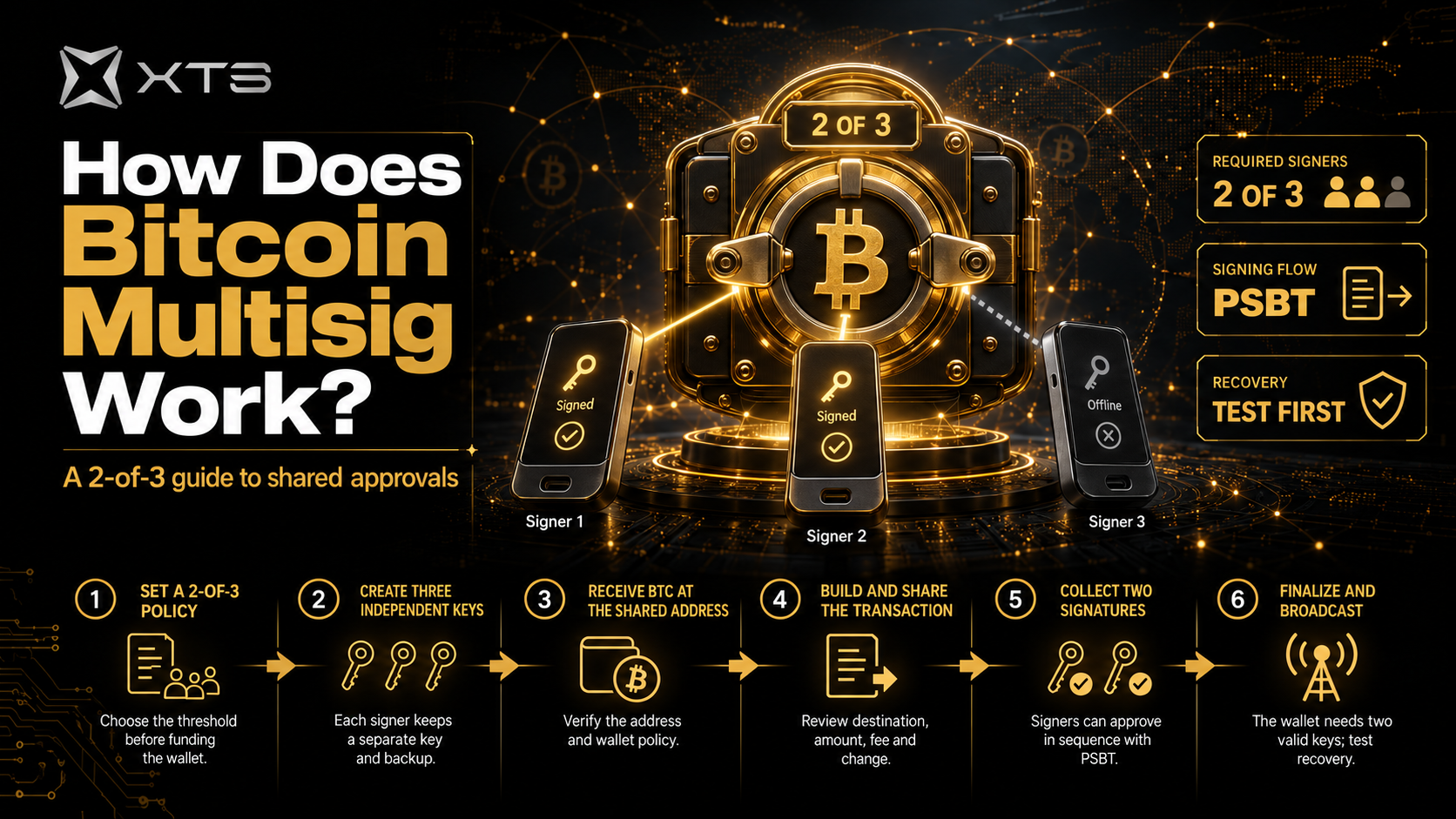
A beginner-friendly guide to M-of-N signing, shared key control, transaction approval, and recovery planning.
Introduction
A standard Bitcoin wallet often authorizes spending with one private key. That arrangement is simple, but a lost or stolen key can create a single point of failure. People who manage shared funds or want extra safeguards may use a multisignature wallet, commonly called a multisig wallet.
A multisig policy requires several keys to participate before Bitcoin can be spent. The policy is often described as M-of-N: at least M keys out of N authorized keys must approve a transaction. A 2-of-3 wallet, for example, can be spent with any two of its three keys.
This can reduce dependence on one device, person, or location. It also adds work. Signers must coordinate, wallet software must understand the same spending policy, and the recovery plan must preserve more information than a single recovery phrase may provide.
This XTS Insights guide explains how Bitcoin multisig works, how people use it, what it can and cannot protect, and how to plan backups before sending funds to a multisig address.
The Short Answer: What Is Bitcoin Multisig?
Bitcoin multisig is a spending arrangement that requires signatures from multiple keys before a Bitcoin transaction can be authorized. In a common script-based M-of-N wallet, any M of the N listed keys can satisfy the spending rule.
For example, a 2-of-3 wallet has three authorized keys and needs valid signatures from any two of them. The keys may be held by different people, stored on separate hardware wallets, or kept in different locations. The exact design depends on the wallet software and the script or signing method it uses.
Multisig does not mean that Bitcoin is stored inside a special device. The blockchain records spendable transaction outputs and the conditions that control them. The wallet keeps or coordinates the keys needed to satisfy those conditions.
How Bitcoin M-of-N Multisig Works
What M-of-N Means
The letter N is the number of authorized keys in the wallet policy. M is the minimum number of valid signatures needed to spend. A 2-of-3 policy has three keys, but a transaction needs only two signatures. A 3-of-5 policy has five keys and needs three signatures.
Each key should represent a separate signing authority. Depending on the goal, that may mean different people, independent hardware wallets, or backups held in separate locations. Copying the same recovery phrase onto several devices does not create several independent keys.
A 2-of-3 Example
Imagine that Alice, Ben, and Chen each control one independently generated key in a 2-of-3 wallet. Any two of them can approve a transaction.
Alice and Ben can sign together.
Alice and Chen can sign together.
Ben and Chen can sign together.
If Alice loses access to her key, Ben and Chen can still spend or move the funds. If one key is stolen, that key alone cannot meet the 2-signature requirement. If two keys are lost and no other recovery path exists, the remaining key cannot satisfy the policy.
This example shows why a threshold is also a recovery decision. The number of keys, who controls them, and where backups are stored determine both security and availability.
What Happens When a Multisig Wallet Receives and Spends Bitcoin?
Receiving Bitcoin
The wallet creates a receiving address from its shared spending policy. A sender can pay to that address without contacting every signer. When the payment is confirmed, the Bitcoin output is controlled by the policy encoded for that address.
Before receiving a large amount, each signer should verify that the wallet shows the same receiving address and policy. A small test payment can help confirm that the wallet is configured as expected.
Spending Bitcoin
Many collaborative wallets use a PSBT, or Partially Signed Bitcoin Transaction, to pass transaction details and signatures between software and signers. The private keys do not need to be bundled into the PSBT.
The wallet application creates a proposed transaction from available Bitcoin outputs.
The transaction is shared with the required signers, often as a PSBT.
Each signer checks the destination, amount, fee, and change output using trusted wallet information or the signer’s display.
Each signer approves and adds a signature with their own key.
The wallet combines enough valid signatures to meet the M-of-N policy, finalizes the transaction, and broadcasts it.
Signers can usually approve one after another rather than being online together. The exact steps depend on the wallet software and device support. Every signer should inspect what they are authorizing; counting signatures alone does not confirm that the transaction pays the intended destination.
Common Bitcoin Multisig Thresholds
1-of-1
A 1-of-1 wallet is the familiar single-key arrangement. It is simple to use and restore, but the one key is a single point of failure.
2-of-2
A 2-of-2 wallet requires both keys for every spend. It can support joint control, but it has no built-in signer redundancy: if either key becomes permanently unavailable, the other key cannot spend alone unless the wallet has a separate recovery path.
2-of-3
A 2-of-3 policy allows any two signers to spend. It can tolerate one unavailable key while preventing one key from authorizing a spend by itself. If two keys are unavailable, the threshold cannot be met.
3-of-5
A 3-of-5 policy can suit a group that wants several independent approvals and some signer redundancy. It requires more coordination and a clearer process for storing, replacing, and recovering keys.
No threshold is best for everyone. Choose one based on who needs to approve, how quickly funds may need to move, which failures the wallet should tolerate, and whether the group can maintain the recovery information.
How Bitcoin Multisig Is Implemented
Script-Based M-of-N Wallets
Bitcoin Script can define a spending condition that accepts a required number of signatures. Earlier standardization work describes M-of-N transactions, and Pay-to-Script-Hash (P2SH) made it possible for a sender to pay to a compact hash while the person spending later supplies the script and signatures.
Modern wallets may use SegWit script formats such as P2WSH, Taproot script paths, or other supported policies. These formats differ in what transaction data they reveal, how much data a spend uses, and which wallets can create or restore them. A wallet’s label alone does not identify every technical detail of its multisig setup.
Multisig and Key Aggregation Are Related but Different
Some collaborative signing methods combine multiple participants’ keys so an on-chain transaction can resemble a single-key spend. MuSig2 is one such scheme for Schnorr signatures. The BIP 327 specification describes it as an interactive n-of-n scheme, not a t-of-n threshold scheme.
That distinction matters. A script-based 2-of-3 wallet can spend with two of three keys. MuSig2, as specified in BIP 327, requires all participants involved in that aggregate key to take part in signing. Wallets may use different technologies behind similar user-facing labels, so check the documentation for the exact signing and recovery model.
Multisig vs a Hardware Wallet
A hardware wallet is a device that protects or uses a private key and signs transactions after the user approves them. Multisig is a policy that requires multiple keys to authorize a spend. They solve different problems and can be used together.
For example, a 2-of-3 wallet could use three separate hardware wallets as its signers. Each device protects one key; the shared wallet policy sets the two-signature threshold. The devices should use independent keys. Three devices initialized from the same recovery phrase still represent the same key authority.
Multisig vs Custodial Wallets
Multisig describes how a transaction is authorized. It does not, by itself, say who controls the keys. In a self-custody arrangement, the user or organization controls enough keys to meet the threshold. A service provider may also hold one key as a co-signer or recovery participant.
If a third party controls enough keys to meet the threshold without the user, that party may have effective control over the funds. Read the custody agreement and understand who can approve a spend, what happens if the provider becomes unavailable, and how keys or funds can be recovered.
Why People Use Bitcoin Multisig
Reduce Reliance on One Key
With a 2-of-3 design, theft or loss of one key may not be enough to move funds, while the other two keys can keep the wallet usable. This works only when the keys and their backups are meaningfully independent.
Share Approval
Families, partnerships, and organizations can require more than one person to approve a payment. A clear policy can reduce the chance that one person makes an unauthorized transfer alone.
Plan for Recovery
A threshold can let a group continue operating after one signer leaves, loses a device, or becomes unavailable. Recovery still depends on preserving the wallet configuration and ensuring enough valid keys remain.
Separate Locations or Responsibilities
Keys can be stored in different places or assigned to people with distinct roles. This can reduce exposure to a single burglary, device failure, or operational error, provided the arrangement does not create an impractical approval process.
Risks and Limitations of Multisig
More Setup and Recovery Work
Every signer needs compatible instructions and a clear way to receive, verify, and sign transactions. A wallet may also need its script policy, output descriptor, public keys, key origins, and derivation paths to rediscover the correct addresses and spending conditions.
A recovery phrase can restore one signer’s key, but it may not reconstruct the whole multisig wallet by itself. Keep the public wallet configuration with the recovery plan. Public keys and descriptors do not authorize spending on their own, but they can reveal address and balance information, so protect them from unnecessary disclosure.
Loss of Too Many Keys
Multisig does not make key loss harmless. If fewer than M usable keys remain and there is no valid recovery path, the funds cannot be spent under that policy. Test recovery before relying on the arrangement.
Common-Mode Failures
Multiple signers provide less protection if they depend on one device, one seed phrase, one cloud account, one backup location, or one person who controls the threshold. Separate the risks the wallet is intended to manage.
Coordination and Compatibility
Signers may be in different locations, use different devices, or rely on wallet software with different support. Agree on the transaction format, communication method, software versions, and what signers must verify before a key is used.
Privacy and Transaction Fees
Some script-based multisig spends reveal more script and signature data on-chain than a basic single-key spend. The effect on privacy and fees depends on the script type, the number of signers, and the transaction. Taproot and key-aggregation designs can change what is visible, but they have their own compatibility and signing requirements.
Approval Does Not Guarantee a Safe Payment
Multisig can enforce that enough keys sign. It cannot determine whether the destination is trustworthy, whether the amount is correct, or whether signers are being deceived. Every signer should independently verify the important transaction details.
How to Plan a Multisig Wallet Safely
Define the problem. Decide whether you need shared approvals, protection from one lost key, a succession plan, or another specific control.
Choose a threshold that fits the people and process. Consider how many signers can be unavailable before funds become inaccessible, and how many approvals are practical for normal use.
Check wallet and device compatibility. Confirm that every signer can create or restore the same policy, inspect addresses, and exchange partially signed transactions.
Generate independent keys. Each key should be created and backed up as a separate signing authority. Do not treat copies of one recovery phrase as independent signers.
Record the complete wallet configuration. Preserve the threshold, public keys or extended public keys, derivation paths, script type, descriptor or wallet policy, and any other data the supported wallet needs for recovery.
Verify the receive address. Compare the address and displayed policy using the signers or software you trust. Do not deposit a large balance before the group has checked the setup.
Test a spend and a recovery. Use a small amount to practice signing and broadcasting. Confirm that a replacement wallet can rediscover the policy and funds from the saved recovery material.
Write down the operating and succession plan. Specify who can approve payments, how keys are replaced, who maintains the configuration, and how authorized successors can recover access.
What Happens If a Multisig Key Is Lost?
The answer depends on the threshold. In a correctly configured 2-of-3 wallet, losing one key still leaves two keys that can meet the policy. The group can create a new wallet with fresh keys and transfer the Bitcoin after checking the new address and recovery plan. Losing two keys leaves only one, which cannot satisfy a 2-of-3 rule.
The group must also be able to identify the wallet’s spending policy. A saved descriptor or equivalent wallet configuration helps compatible software derive the same addresses and understand which keys belong to the wallet. Protect key backups and configuration records separately where that reduces the risks you identified, while keeping enough information available for legitimate recovery.
If a key may have been copied by someone unauthorized, treat that key as compromised. Adding a new device with the same compromised recovery phrase does not create a new secret. A planned move to a newly generated multisig policy may be appropriate, with all remaining signers verifying the transaction and destination.
Common Misconceptions About Bitcoin Multisig
“A 2-of-3 Wallet Needs All Three Signers”
No. It needs two valid signatures from the three keys in the policy. A different threshold, such as 3-of-3, requires all three.
“Three Hardware Wallets Always Mean Three Independent Keys”
No. If each device contains the same key or was restored from the same recovery phrase, they may represent one signing authority. Independent keys must be generated and backed up independently.
“A Recovery Phrase Is Enough to Restore Any Multisig Wallet”
Not always. The phrase may recover one key, while the wallet also needs the threshold, public keys, derivation data, script type, and descriptor or policy to reconstruct the full arrangement.
“Multisig Makes a Wallet Anonymous”
No. Bitcoin transactions are public. Some spending conditions or signer information may become visible when funds are spent. Privacy depends on the script, wallet behavior, address reuse, and how transactions are connected to identities.
“Multisig Prevents Phishing and Bad Approvals”
No. It raises the number of approvals needed, but signers can still be tricked into approving the same fraudulent transaction. Each signer should verify the destination, amount, fee, and change information.
“Multisig Is Always Safer Than a Single-Key Wallet”
No. A well-tested single-key wallet may be easier to back up and restore than a multisig wallet whose configuration is incomplete. Security depends on the threat model, key independence, software support, and recovery practice.
Who Might Benefit from Bitcoin Multisig?
Multisig may help people or organizations that need shared approval, want a recovery path for one unavailable key, or manage funds that should not be movable by a single person or device. It can also support planned handover when roles change.
It may be unnecessary for small everyday balances or for users who cannot reliably manage separate keys and configuration backups. A wallet should match the user’s ability to operate it, not simply the number of security features it offers.
How XTS Views Bitcoin Multisig
At XTS, we view multisig as a way to encode approval and recovery rules into a Bitcoin wallet. Its value comes from a policy that people understand and can operate under normal and emergency conditions.
The threshold is only one part of the design. Key generation, signer independence, device compatibility, transaction checks, wallet descriptors, backup locations, and succession plans all affect whether the wallet works as intended.
Readers considering multisig should document the policy and practice the full recovery process before relying on it. A setup that nobody can restore or use during an urgent payment does not provide dependable control.
Frequently Asked Questions
What Is Bitcoin Multisig in Simple Terms?
Bitcoin multisig is a wallet arrangement that needs signatures from more than one key to authorize a spend. A 2-of-3 setup, for example, allows any two of three keys to approve a transaction.
What Does 2-of-3 Multisig Mean?
It means three keys are authorized and any two valid signatures are enough to spend. One key can be unavailable while the other two still meet the policy. If two keys are lost, the remaining key is not enough.
Do All Signers Need to Be Online at the Same Time?
Usually not. Signers can often approve a transaction sequentially by passing a PSBT or another supported signing package between them. Wallet support and the signing workflow determine the exact process.
Can a Multisig Wallet Receive Bitcoin Without All Signers?
Yes. A sender can pay to a multisig address without contacting the signers. The required keys are needed later to spend funds, according to the wallet’s policy.
Can a Multisig Wallet Be Restored from One Seed Phrase?
One phrase may restore one signer’s key. The complete wallet may also require the threshold, the other public keys, derivation information, script type, and a wallet descriptor or equivalent configuration.
Is a Hardware Wallet the Same as a Multisig Wallet?
No. A hardware wallet protects a key and signs transactions. Multisig requires a set number of keys to approve a spend. Several hardware wallets can act as signers in one multisig wallet.
Does Bitcoin Multisig Cost More to Use?
A script-based multisig transaction can include more data than a basic single-key spend, which may affect the fee at the same fee rate. The exact difference depends on the script type, threshold, and transaction structure.
Is Bitcoin Multisig Anonymous?
No. Bitcoin transactions are public. What a blockchain observer can learn about signers and policies depends on the wallet’s script and signing method, but multisig should not be treated as an anonymity tool.
Can a Company or Custodian Be One of the Signers?
Yes, if the wallet software and agreement support that arrangement. Understand how many keys the company controls, whether it can meet the threshold without you, and what happens if the service becomes unavailable.
How Should I Test a Multisig Wallet?
Before depositing a significant amount, confirm the receiving address with the signers, send a small test payment, practice a complete spend, and verify that the wallet can be reconstructed from the saved keys and policy information.
Conclusion
Bitcoin multisig uses multiple keys to enforce a spending rule such as 2-of-3. It can reduce reliance on one key and make shared approval possible, while still allowing a wallet to tolerate some signer outages when the threshold is chosen for that purpose.
The same arrangement adds requirements. Signers need compatible tools, must check transaction details, and need a recovery plan that preserves both the key material and the wallet’s public policy information. Losing too many keys or the information needed to reconstruct the wallet can make funds inaccessible.
Before using multisig for meaningful funds, choose a threshold that fits the people involved, test a small transaction, and practice recovery. Review the current documentation for every device and wallet in the setup.
Key Takeaways
- Bitcoin multisig requires multiple keys to satisfy a spending policy.
- M-of-N means any M valid keys out of N authorized keys can approve a spend.
- A 2-of-3 wallet can tolerate one unavailable key, but two unavailable keys cannot meet the threshold.
- Hardware wallets can protect individual signers; multisig defines how many signers must approve.
- A recovery phrase may restore one key but not the complete wallet policy or descriptor.
- MuSig2 is an interactive n-of-n key-aggregation scheme, not the same as script-based t-of-n multisig.
- Signers must verify transaction details and test recovery before relying on the wallet.
Leave a Reply